Dropshipping vs Traditional Retail (2026)
Dropshipping vs traditional retail compared on startup cost, margins, risk and control. See which model actually fits your budget, your goals and your time.
Choosing between dropshipping and traditional retail comes down to your budget, risk tolerance, and how much control you want over the customer experience. Here's the short answer:
-
Dropshipping: Start for $500–$3,000, no inventory to manage, easy to test products. Lower profit margins (10–30%) and less control over shipping and quality.
-
Traditional retail: Requires $10,000–$100,000+ upfront, but delivers higher margins (30–60%+), full brand control, and better customer retention.
If you're wondering how to start dropshipping with minimal risk, it's the easier entry point. If you have capital and want to build a premium brand, traditional retail offers more long-term upside. Many successful businesses start with dropshipping and transition their best sellers to in-house inventory.
Quick Comparison
| Factor | Dropshipping | Traditional Retail |
|---|---|---|
| Startup Costs | $500–$3,000 | $10,000–$100,000+ |
| Profit Margins | 10–30% | 30–60%+ |
| Inventory | No inventory to manage | Requires upfront purchase + storage |
| Control | Limited (supplier-dependent) | Full control over operations |
| Scalability | Easy to start, margin ceiling | Complex but higher potential |
| Customer Experience | Limited customization | Full control over branding + fulfillment |
| Best For | Testing products, beginners, low budget | Brand builders, high capital, long-term |
What Is Dropshipping?
Dropshipping is a retail model where you sell products online without holding any inventory. When a customer places an order on your dropshipping store, you forward the order to a third-party supplier who ships the product directly to the customer. You never touch or store the product.
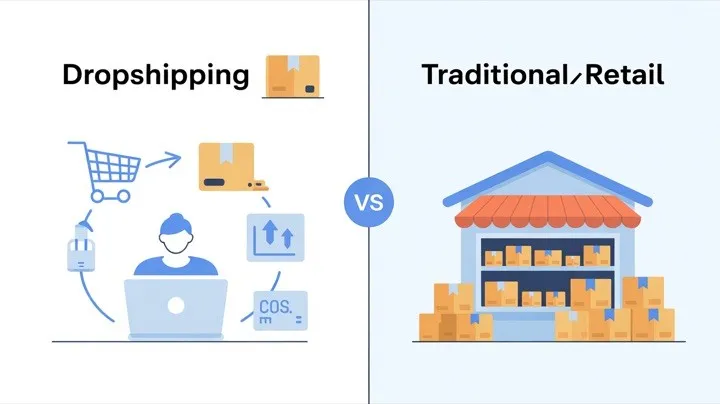
"Dropshipping is a business model where items bought from an online store are shipped directly to customers by the supplier or manufacturer." — Shopify
The model has exploded in popularity, particularly in the United States, where the majority of dropshipping stores are based. The global dropshipping market generated hundreds of billions in sales as of 2025, and the North American market is projected to reach $281.59 billion by 2030 (Grand View Research).
For anyone wondering how to do dropshipping, the process is straightforward:
-
Find products from suppliers on AliExpress, Alibaba, or Amazon
-
List them in your Shopify store at your own prices
-
Customer buys from your store — you collect payment
-
Forward the order to the supplier, who ships directly to the customer
-
You keep the margin between your selling price and supplier cost
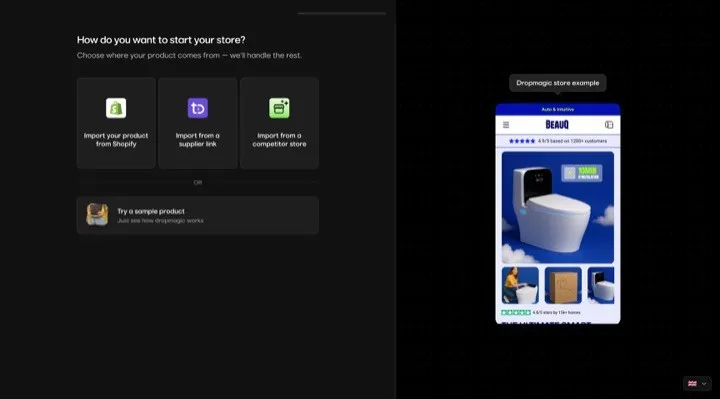
Modern tools make this process even faster. An AI store builder like Dropmagic can set up your entire dropshipping store — including product imports, descriptions, branding, and design — in under 30 minutes. See our step-by-step store building guide for the full walkthrough.
Benefits of Dropshipping
-
Low startup costs — No inventory investment means minimal financial risk. You can start dropshipping for free or with just a few hundred dollars.
-
Product testing flexibility — Test dozens of products without buying inventory. If something doesn't sell, remove it instantly.
-
Location independence — Run your dropshipping stores from anywhere with an internet connection.
-
Wide product selection — No warehouse limitations means you can offer thousands of products.
-
AI automation — Tools like Dropmagic automate product imports, description writing, and store design. See how AI finds winning products for more on this.
Dropshipping margins typically range from 20–30%, and some ecommerce retailers achieve margins exceeding 50% by avoiding inventory holding costs (Shopify, 2025). Compare that to traditional retail's average net margins of 3–10% after accounting for inventory, storage, and staffing costs.
"When you are starting a virtual store and do not have enough capital to invest in an initial stock, dropshipping is presented as a very attractive alternative. This model significantly reduces the financial risk." — Bruno Brito, Dropshipping Specialist and CEO of Empreender, quoted by Wix
Drawbacks of Dropshipping
-
Quality control limitations — You never handle the product, so you depend entirely on supplier quality
-
Shipping inconsistencies — Multiple suppliers mean variable shipping times and packaging standards
-
Supplier dependency — Stock shortages, delays, or discontinued items are outside your control
-
High competition — Low barriers to entry mean many sellers offer the same products, driving price wars
-
Customer service complexity — Returns and exchanges require coordination with suppliers who each have different policies
What Is Traditional Retail?
Traditional retail is the established model: you purchase products in bulk from wholesalers or manufacturers, store them yourself, and ship orders directly to customers. You own the inventory and control every step of the fulfillment process.
Despite the growth of ecommerce, about 84% of U.S. retail sales still happen in physical stores (U.S. Census Bureau). Even for online-only traditional retailers, the model remains dominant because it offers control that dropshipping can't match.
Benefits of Traditional Retail
-
Higher profit margins — Wholesale purchasing enables gross margins of 45–60%, significantly higher than dropshipping's 15–30%
-
Full quality control — Inspect every product before it reaches customers. Create memorable unboxing experiences that reinforce your brand.
-
Better customer retention — Traditional e-commerce businesses enjoy a 12% higher customer retention rate compared to dropshipping. For existing customers, in-person product evaluation lifts both average spend per visit and long-term sales.
-
Brand differentiation — Control every touchpoint: product quality, packaging, insert cards, shipping speed, and customer service
-
Shipping control — Fast, reliable fulfillment that meets American consumers' expectations for 2–3 day delivery
Drawbacks of Traditional Retail
-
High upfront investment — Inventory alone requires $20,000–$50,000 in initial capital, plus ongoing costs for storage, insurance, and staffing
-
Inventory risk — Poor inventory management costs retailers worldwide enormous sums every year. Unsold stock ties up capital; stockouts drive customers away permanently — most shoppers who encounter repeated stockouts will never return**
-
Operational complexity — As you scale, managing warehousing, fulfillment, and returns becomes increasingly complex. Many online shoppers abandon purchases over slow delivery, and a wrong order is one of the most reliable ways to lose a customer for good
-
Limited product testing — Testing new products requires purchasing inventory upfront, increasing financial risk
Detailed Comparison: Dropshipping vs Traditional Retail
Beyond the basics, here's how the two models compare across every dimension that matters:
| Dimension | Dropshipping | Traditional Retail |
|---|---|---|
| Startup Investment | $500–$3,000 (website, marketing, platform subscription) | $10,000–$100,000+ (inventory, warehousing, equipment, marketing) |
| Gross Profit Margins | 15–30% typical | 45–60% achievable |
| Inventory Management | None — supplier handles stock | Full responsibility: purchasing, storage, tracking |
| Quality Control | Limited — supplier-dependent | Complete control over product standards |
| Shipping Speed | Variable (7–30 days from overseas suppliers) | Fast (2–5 day U.S. shipping typical) |
| Customer Retention | Lower — harder to differentiate | Modestly higher retention |
| Scalability | Easy initially, margin ceiling limits growth | Harder to start, better margins at scale |
| Risk Level | Low financial risk, high supplier dependency | High financial risk, full operational control |
| Location Freedom | Work from anywhere | Requires storage/warehouse space |
| Product Testing | Free — add/remove products instantly | Expensive — requires inventory purchase |
| Brand Control | Limited customization of fulfillment | Full control over entire customer journey |
| Best For | Beginners, market testing, low-budget launches | Established brands, high-capital businesses |
The 20–30% margin gap between models is the most significant difference. Traditional retail achieves higher margins through bulk purchasing and direct supplier relationships. However, dropshipping's zero-inventory model means you can be profitable from your first sale — no need to sell through thousands of units to recover inventory costs.
For U.S.-based businesses specifically, shipping speed is a critical differentiator. American consumers increasingly expect 2–3 day delivery, which is difficult to achieve with overseas dropshipping suppliers. Solutions include using U.S.-based suppliers, working with fulfillment agents, or transitioning best sellers to in-house inventory.
How to Start Dropshipping: The Practical Path
If you've decided dropshipping is the right starting point, here's how to dropship effectively:
Step 1: Choose Your Niche and Products
Focus on a specific niche rather than selling everything. Use tools like Dropmagic's AI product finder to identify products with high demand, reasonable margins, and manageable competition.
Step 2: Build Your Dropshipping Store
The fastest approach is using an AI Shopify store builder. Dropmagic generates your entire store — theme, branding, product pages, and navigation — from a single prompt. You can build a Shopify store in under 30 minutes.
For a full feature breakdown of what AI store builders offer, see AI store builder features explained. To compare different building tools, see our best Shopify themes and AI store builders guide.
Step 3: Set Up Fulfillment
Connect your store to a fulfillment tool like DSers for automated order processing. Our guide covers how to dropship on Shopify for free using DSers step by step.
Step 4: Launch and Optimize
Use AI templates to create high-converting landing pages and product layouts. Follow our store launch checklist to ensure nothing is missed.
For the complete process from zero to first sale, our complete dropshipping guide covers everything.
Digital Dropshipping: The Evolution of the Model
A growing segment of dropshipping focuses on digital products — ebooks, templates, software, courses, and printable designs. Digital dropshipping eliminates shipping entirely, offers margins of 70–90%, and scales infinitely since there's no physical inventory or fulfillment.
For entrepreneurs who want the benefits of dropshipping without the shipping headaches, digital products represent the highest-margin path.
See our full guide: What Is Digital Dropshipping? The Complete Guide.
Making Money: Strategies for Each Model
Maximizing Dropshipping Profits
Profitability in dropshipping depends on three levers:
-
Product selection — Focus on niche products with high perceived value. Avoid commoditized items where you'll compete solely on price.
-
Marketing efficiency — Invest in targeted advertising, email marketing, and content marketing to drive qualified traffic. Dynamic pricing and seasonal adjustments improve margins.
-
Operational automation — Use AI tools to automate product descriptions, store design, and order processing. Every hour saved is margin preserved. Learn more about best ecommerce platforms for dropshipping
Maximizing Traditional Retail Profits
Traditional retail profitability comes from operational efficiency:
-
Bulk purchasing — Negotiate volume discounts with suppliers. Margins improve significantly at scale.
-
Just-in-time inventory — Reduce carrying costs by ordering based on demand forecasts rather than speculative bulk orders.
-
Brand premium — Build a brand that commands higher prices. Customers pay more for trust, consistency, and quality.
-
Upselling and cross-selling — Increase average order value through product bundles, related product suggestions, and tiered pricing.
The Hybrid Approach: Start Dropshipping, Transition Winners
The smartest entrepreneurs use both models. Here's the pattern that successful ecommerce operators follow:
Phase 1: Dropship to test — Launch a dropshipping store to identify which products sell. This costs almost nothing and gives you real market data.
Phase 2: Bring winners in-house — Once you identify your top 5–10 products, source them directly from manufacturers and stock them yourself. Margins jump from 20% to 45–60%.
Phase 3: Keep dropshipping for catalog breadth — Continue dropshipping complementary products while focusing in-house resources on proven sellers.
Real-world examples of this approach:
-
A kitchen gadget store moved its top 10 products in-house, increasing margins from 20% to 45% while dropshipping the broader catalog
-
A pet accessories brand created their own premium collar line after identifying demand through dropshipping. In-house products (40% of catalog) now generate 75% of profits
-
An outdoor gear shop stocks best-selling camping equipment in-house (30% of catalog) and uses dropshipping to test seasonal products
How Dropmagic Supports Both Models
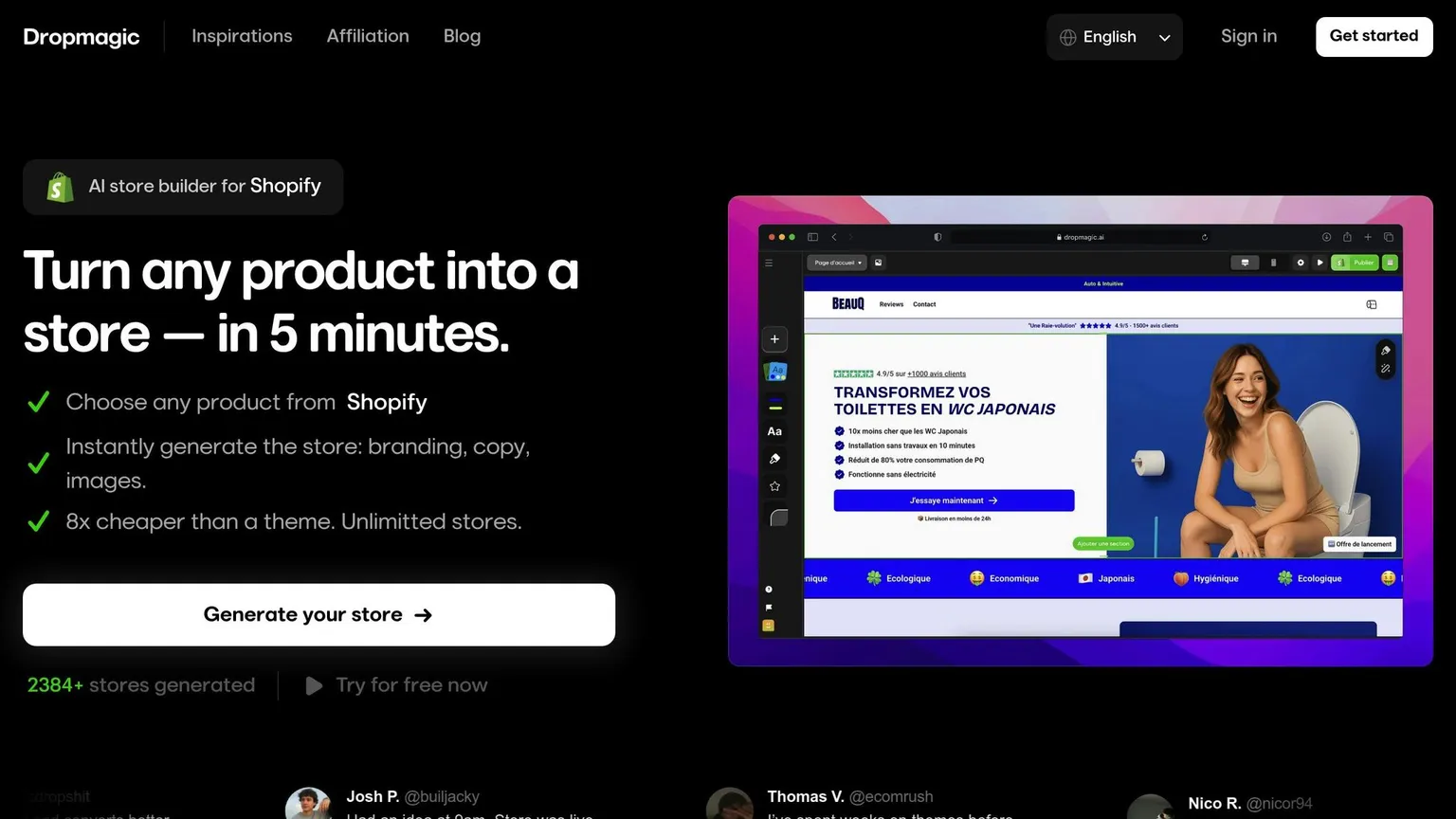
Whether you choose dropshipping, traditional retail, or the hybrid approach, Dropmagic provides the tools to launch and scale:
For dropshipping:
-
Convert product URLs from AliExpress, Amazon, or Alibaba into full Shopify product pages in seconds
-
AI-generated product descriptions trained on 8-figure brand copy
-
Test multiple store concepts in a single day
-
See all AI store builder features
For traditional retail:
-
Professional store design with 50+ conversion-focused sections
-
Conversion-optimized Shopify sections based on ecommerce best practices
-
Mobile optimization by default (81% of Shopify traffic is mobile)
-
Visual drag-and-drop editor for ongoing customization
For comparisons with other store building tools, explore our AI store builder comparisons.
Which Model Should You Choose?
Your decision depends on three factors:
1. Capital available
-
Under $3,000 → Start with dropshipping
-
$10,000–$50,000 → Consider traditional retail or the hybrid approach
-
$50,000+ → Traditional retail with potential dropshipping for catalog expansion
2. Risk tolerance
-
Low risk tolerance → Dropshipping (test products without inventory investment)
-
Moderate risk tolerance → Hybrid (dropship first, bring winners in-house)
-
Higher risk tolerance → Traditional retail (bigger upfront bet, bigger upside)
3. Long-term vision
-
Want to test business ideas quickly → Dropshipping
-
Want to build a premium brand → Traditional retail
-
Want to do both → Hybrid approach (most common path for successful operators)
"The only way to be successful in dropshipping nowadays is to have a real identity as a brand, and have a real legitimate business, even if it's not legit to start with. If you're still shipping from AliExpress, you still have to be believable. People have to trust you." — Cole Turner, 7-figure dropshipping entrepreneur, interviewed by Oberlo
With the global dropshipping market at $351.8 billion in 2024 and growing at a 23.4% CAGR and traditional e-commerce maintaining a 12% customer retention advantage, both models offer real opportunities. The key is matching the model to your resources and goals.
For a complete roadmap on getting started, see our complete dropshipping guide or explore the 10 best dropshipping stores for inspiration.
FAQs
What should I consider when choosing between dropshipping and traditional retail?
The three biggest factors are startup capital, risk tolerance, and brand control goals. If you have limited funds and want to test products quickly, dropshipping lets you start for $500–$3,000 with zero inventory risk. If you have $10,000+ and want full control over product quality, packaging, and customer experience, traditional retail offers higher margins (30–60%) and better retention. Many successful businesses combine both — using dropshipping to test products and traditional retail for proven sellers.
How do I handle quality control and customer service in dropshipping?
Start by vetting suppliers thoroughly — order samples before listing any product. Establish clear quality standards with suppliers and maintain regular communication. For customer service, set transparent expectations around shipping times and product specifications. Use AI tools to automate common responses and invest in a returns process that's clear to customers. Building strong supplier relationships is the single most important factor in dropshipping quality control.
How can traditional retailers manage high upfront costs effectively?
Focus on just-in-time inventory to reduce carrying costs, use demand forecasting to avoid overstock, and start with a focused product range rather than a broad catalog. Build strong supplier relationships to negotiate volume discounts and favorable payment terms. Consider the hybrid approach: dropship to identify winners first, then bring only proven products in-house to minimize inventory risk.
Can I start dropshipping with no money?
Nearly. Tools like Buildyourstore ai offer free store generation, Dropmagic offers a free trial, and Shopify's first 3 months cost just $1/month. The only hard requirement is the Shopify subscription. See our complete guide on how to start dropshipping for free for the full breakdown of zero-cost and near-zero-cost approaches.
What are the latest dropshipping trends for 2026?
The biggest trends are AI-powered store creation, digital dropshipping (selling digital products without shipping), and the hybrid model (combining dropshipping with in-house inventory for top sellers). AI store builders now generate complete stores in minutes, making it easier than ever to test new niches. For more, see our dropshipping news and trends coverage.
Looking for an AI-powered way to build your dropshipping store? See our complete guide to AI dropshipping store builders in 2026.