How AI Finds Winning Dropshipping Products
How AI product research finds winning dropshipping products: trend detection, margin analysis and competitor gaps. The data-driven way to pick a winner.
Product research is where most dropshipping businesses succeed or fail. Pick the wrong product and no amount of marketing or store optimization will save you. Pick the right one and everything else becomes easier — ads convert, margins hold, and customers come back.
Traditionally, finding winning products meant hours of manual research: scrolling AliExpress, checking Google Trends, spying on competitor ads, and guessing which products might work. AI has fundamentally changed how to do dropshipping product selection by analyzing thousands of data points simultaneously — sales velocity, social engagement, search trends, competitor gaps, and margin potential — to surface products with the highest probability of success.
This guide covers how AI product research actually works, what data it analyzes, and how to use it when you're learning how to start dropshipping.
What Makes a "Winning" Dropshipping Product?
Before diving into how AI finds products, it helps to define what a winning product actually looks like:
| Criteria | What to Look For | Why It Matters |
|---|---|---|
| Demand signal | Rising search volume, social engagement, marketplace sales velocity | Confirms people actually want this product |
| Profit margin | 30%+ after product cost, shipping, and ad spend | Below 30% leaves no room for testing and scaling |
| Low competition saturation | Not yet sold by hundreds of dropshipping stores | Saturated products have compressed margins and ad fatigue |
| Impulse purchase potential | Under $50, solves a visible problem, "I need this" factor | Higher-priced items need more trust-building |
| Not easily found locally | Specialty/niche items not in big-box stores | If Amazon delivers it next-day for cheaper, you lose |
| Visual appeal | Photographs well, demo-friendly for video ads | Products that look good in ads get cheaper clicks |
A successful dropshipping product generally carries a 2.5–3x markup from supplier cost. AI doesn't replace your judgment on these criteria — it accelerates the data gathering so you can evaluate products against them faster.
How AI Product Research Actually Works
AI product research tools analyze data from multiple sources simultaneously. According to a McKinsey Global Survey, 72% of organizations now use AI in at least one business function — and ecommerce product research is one of the fastest-growing applications. Here's what happens behind the scenes:
Data Sources AI Monitors
Marketplace sales data. AI tracks sales velocity, pricing trends, and review volume on Amazon, AliExpress, and other platforms. A product with rapidly increasing sales but relatively few sellers signals opportunity.
Social media trends. Platforms like TikTok, Instagram, and Facebook are where dropshipping products often go viral first. According to Statista, TikTok Shop generated roughly $33 billion in global GMV in 2024. AI monitors engagement patterns — not just views, but saves, shares, and comments that indicate purchase intent. TikTok alone drives discovery for millions of products, and AI can detect trending products days before they saturate.
Search engine data. Rising Google search volume for specific product terms signals growing demand. AI tracks not just volume but velocity — a product searched 1,000 times this month that was searched 200 times last month is more interesting than one consistently at 5,000.
Competitor intelligence. AI monitors which products other dropshipping stores are advertising, what ad copy they're using, and how long they've been running those ads. A product with active ads running for 30+ days likely has proven demand and healthy margins.
Supplier and logistics data. AI evaluates supplier reliability (order fulfillment rates, shipping times, return rates) alongside product data. A trending product from an unreliable supplier isn't a winning product.
The Analysis Pipeline
AI doesn't just collect data — it scores and ranks products through a pipeline:
-
Trend detection — identifies products with rising demand signals across multiple platforms
-
Margin calculation — estimates profit after product cost, shipping, estimated ad spend, and platform fees
-
Competition assessment — measures how many stores are already selling the product and how saturated the ad landscape is
-
Risk scoring — flags potential issues like seasonal dependency, IP/trademark concerns, or supplier instability
-
Recommendation — surfaces the highest-opportunity products ranked by a composite score
This pipeline processes thousands of products in minutes — work that would take a human researcher weeks.
AI Product Research vs Manual Research
| Factor | Manual Research | AI-Powered Research |
|---|---|---|
| Products analyzed | 10–30 per day | Thousands per day |
| Data sources | 2–3 (typically AliExpress + Google Trends) | 5–10+ simultaneous sources |
| Trend detection speed | Days to weeks behind | Near real-time |
| Margin calculation | Manual spreadsheet estimates | Automated with current pricing data |
| Competition analysis | Spot-checking competitor stores | Systematic ad library and store monitoring |
| Bias | Influenced by personal preferences | Data-driven (but limited by data quality) |
| Cost | Time-intensive (your most expensive resource) | Tool subscription + review time |
| Best for | Final validation and gut-check | Initial discovery and shortlisting |
The most effective approach combines both: AI handles the initial discovery and data analysis, you apply judgment on brand fit, audience alignment, and gut instinct.
Product Research When Learning How to Start Dropshipping
If you're figuring out how to start dropshipping, product research is the critical first step. Here's how to approach it:
Start with a niche, not a product. AI works better when you give it direction. "Find me a winning product" is too broad. "Find trending home organization products under $30 with 40%+ margins" gives AI the parameters to surface useful results.
Validate with multiple signals. A product trending on TikTok but with zero Google search volume might be a flash-in-the-pan. Look for products with rising signals across at least 2–3 data sources.
Calculate your real margins. When learning how to dropship, beginners consistently underestimate costs. According to Shopify, the average dropshipping profit margin is 15–20%. Include: product cost, shipping to customer, payment processing (2.9% + $0.30), ad spend per acquisition (typically $10–30 for beginners), returns and refunds (typically 5–10%), and Shopify subscription. AI margin calculators help, but double-check the assumptions.
Test fast, cut fast. The AI advantage isn't finding one perfect product — it's rapidly identifying 5–10 candidates so you can test them with small ad budgets and let data determine the winner. For a step-by-step process, see our complete dropshipping guide (2026).
Using Dropmagic for Product Research and Store Launch
While dedicated product research tools focus solely on finding products, an AI store builder like Dropmagic combines product research with instant store creation:
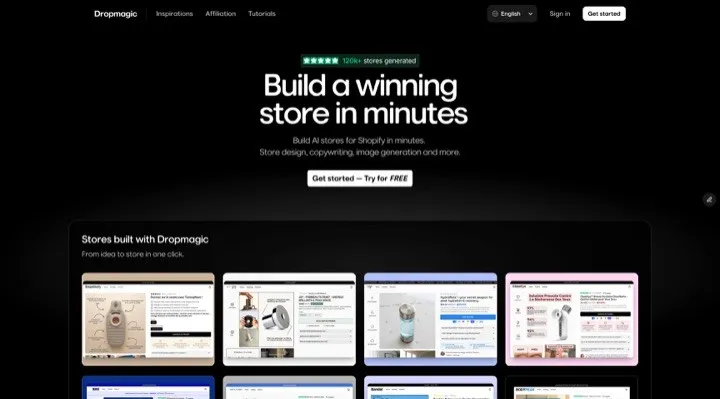
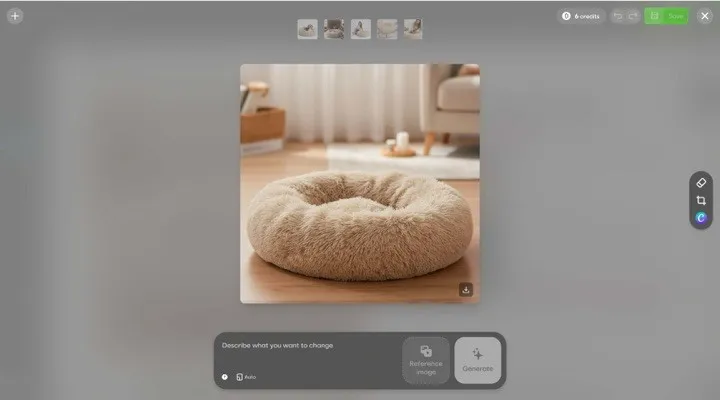
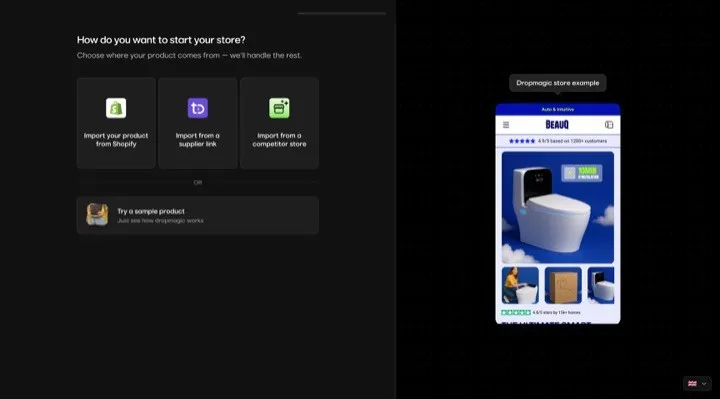
Product import and analysis. Paste a product URL from Amazon, AliExpress, or Alibaba. Dropmagic imports the product — images, variants, pricing — and generates an optimized product page automatically. This lets you go from "this looks promising" to "live store testing this product" in minutes instead of days.
Rapid testing workflow. The speed advantage of an AI Shopify store builder is most powerful during product testing. Instead of spending a week building a store for one product, you can launch multiple dropshipping stores for different products and let ad performance determine which one wins.
As one Dropmagic user put it: "I tested 4 products in one week with Dropmagic, built 4 stores, and found a winner."
AI-generated product copy. The AI creates product descriptions, headlines, and meta tags optimized for both conversions and SEO — Nielsen Norman Group traces 20% of failed purchases to incomplete or unclear product information, which is what generic supplier text leaves behind. See how to write product descriptions that convert for the copywriting principles behind this.
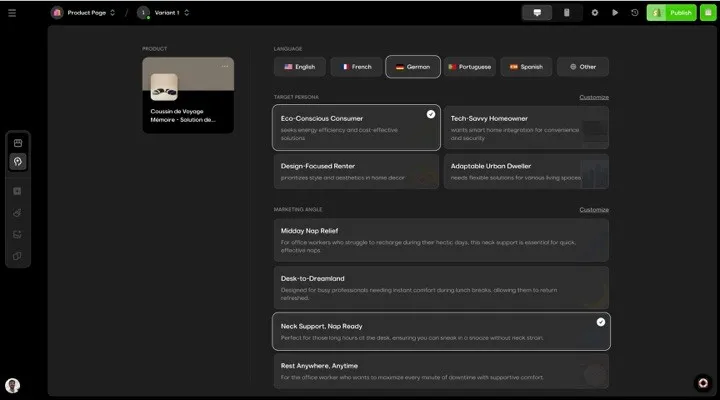
Multilingual testing. If you're exploring international markets, Dropmagic generates native-language product pages in 40+ languages. This lets you test whether a product resonates in different markets simultaneously — a key advantage for digital dropshipping where geography doesn't limit your audience.
Want to see how Dropmagic compares to other AI tools? Visit our AI store builder comparison hub or read specific matchups like PagePilot vs Dropmagic, Atlas vs Dropmagic, and Kopy vs Dropmagic.
Product Selection Frameworks
Use these frameworks to evaluate AI-surfaced products:
The 5-Filter Framework
Run every product candidate through these five filters in order:
-
Demand filter — Is there evidence people want this? (Search volume, social engagement, marketplace sales)
-
Margin filter — Can you sell it profitably after ALL costs including ads? (Target 30%+ net margin)
-
Competition filter — How saturated is this product in the dropshipping market? (Check Facebook Ad Library, competitor stores)
-
Logistics filter — Can it ship reliably to your target market in acceptable timeframes? (Under 2 weeks for US)
-
Scalability filter — If this product wins, can you scale spend without supply issues? (Multiple suppliers, consistent stock)
A product that passes all five filters is worth testing. Most products fail at filter 2 or 3.
Seasonal vs Evergreen Assessment
| Product Type | Characteristics | Strategy |
|---|---|---|
| Evergreen | Consistent demand year-round | Build a branded dropshipping store around it, invest in SEO |
| Seasonal | Demand spikes around events/seasons | Launch 4–6 weeks before peak, extract maximum profit, move on |
| Trend-based | Viral spike then decline | Move fast, test immediately, don't over-invest in store |
AI is particularly valuable for seasonal and trend-based products because timing is critical — by the time you manually discover a trending product, the window may already be closing.
Common Product Research Mistakes
Falling in love with the product. You're not buying this product — your customers are. Products you personally find boring (pet accessories, phone mounts, kitchen gadgets) often outperform products you think are "cool."
Ignoring ad cost reality. A product with 50% markup sounds profitable until you realize customer acquisition costs $25 on a $30 product.The average cost per click for Facebook ecommerce ads is $0.70–$1.50 — always model ad spend into margin calculations.
Chasing trends too late. If you see a product on a "winning products" YouTube video, thousands of other dropshippers saw it too. AI gives you a speed advantage here — but only if you act on the data quickly.
Over-researching, under-testing. Spending two weeks finding the "perfect" product is worse than spending two days finding three "good enough" products and testing all three. Speed of testing beats depth of research when learning how to do dropshipping.
Skipping supplier validation. AI can surface a great product from a terrible supplier. Always order a sample, check shipping times, and verify product quality before scaling. For more pitfalls to avoid, see common store setup mistakes and how to fix them.
How to Start Dropshipping for Free with AI Research
You don't need expensive tools to get started with AI-powered product research. Here's a free stack:
-
Google Trends — free trend data for any search term, with geographic and temporal filtering
-
TikTok Creative Center — shows trending products and ad performance data
-
Facebook Ad Library — see what products competitors are advertising and for how long
-
AliExpress Dropshipper Center — basic sales and trend data for supplier products
-
Dropmagic free trial — test the full AI store building workflow including product import
For the complete guide on launching without upfront investment, see how to start dropshipping for free in 2026.
FAQs
Can AI really predict which products will sell?
AI doesn't predict the future — it identifies patterns. Products with rising demand across multiple data sources, healthy margins, and manageable competition have a statistically higher chance of success. Think of AI as improving your batting average, not guaranteeing home runs.
How much should I spend testing a product before deciding it's a winner or loser?
A common framework: spend $50–100 on ads (or enough to generate 1,000+ impressions) per product. If you get zero sales or engagement, move on. If you get some sales but margins are tight, optimize the page and ad creative before scaling. If you get profitable sales immediately, you've likely found a winner. The key is setting a testing budget and sticking to it — don't throw $500 at a product hoping it will eventually work.
What's the difference between product research tools and an AI store builder?
Product research tools (like Sell The Trend, Niche Scraper) focus on finding products. An AI store builder like Dropmagic goes further — it finds products AND builds the entire dropshipping store around them including branding, product pages, descriptions, and Shopify integration. This matters because the speed from "product found" to "store live and testing" is the real competitive advantage in dropshipping.
How do I know if a product is already too saturated?
Check the Facebook Ad Library for your product — if dozens of stores are running ads for the same product, saturation is high. Check AliExpress order counts — products with 50,000+ orders are likely saturated. Search for the product on Google — if page 1 is full of dropshipping stores selling it, competition is intense. Some saturation is fine (it proves demand), but heavy saturation means higher ad costs and lower margins.
Should I focus on one product or multiple products when starting?
Test 3–5 products simultaneously if your budget allows, or sequentially if it doesn't. A one-product store lets you build a more focused brand, but you're betting everything on that product working. Testing multiple products with an AI store builder that can generate stores quickly reduces your risk significantly — you find winners faster.
How does AI product research work for digital dropshipping?
Digital dropshipping — selling digital products like templates, courses, and software — requires different research signals. AI monitors download volumes, review sentiment on marketplaces like Gumroad and Creative Market, social media mentions, and search trends for digital product categories. The margin advantage (60–90% vs 10–30% for physical products) means even moderate demand can be highly profitable.
Looking for an AI-powered way to build your dropshipping store? See our complete guide to AI dropshipping store builders in 2026.