Nas.com vs DropMagic (2026): Own or Rent Your Store?
Nas.com vs DropMagic compared: an all-in-one selling platform versus a store you own on Shopify. Pricing, AI features, ownership, and platform lock-in.
Most "AI store builder" comparisons pit one thin Shopify app against another. This Nas.com vs DropMagic comparison is different, because Nas.com is not a thin app — it is a serious, well-funded platform built by one of the internet's most-followed creators, and it is chasing a bigger idea than a single storefront.
Nas.com is the rebrand of Nas.io, launched in April 2026 alongside a $27 million Series A led by Khosla Ventures. Founder Nuseir Yassin — the Nas Daily creator, with roughly 70 million followers — even paid $1.25 million of his own money to buy the Nas.com domain. The pitch is simple and genuinely appealing: start selling from a single photo. Snap a product, and AI builds your storefront, writes your content, and runs your ads.
So this is not a "beware the scam" review. It is a real fork in the road. Nas.com and DropMagic both use AI to spin up a store fast, but they answer one question in opposite ways: where does your store actually live, and who owns it?
TL;DR: Nas.com is an all-in-one commerce platform — your storefront, payments, and Meta ads live inside Nas.com, starting at $9/month (Basic) or $29/month (Pro, with built-in ads) after a 7-day trial. DropMagic is a free AI Shopify store builder that generates a complete, uniquely designed store and publishes it to your own Shopify account — you build for free and only pay when you publish. Nas.com is convenient and self-contained. DropMagic is portable and yours. That single difference decides which one you should use.
What Is Nas.com?
Nas.com is an AI-first commerce platform for solo sellers, creators, and small brands. Its stated mission is to let people sell what they make "without the gatekeepers, the monthly fees, or the platforms that own your customers." According to the company, the platform has 3.5 million members and grew revenue 5x in 2025.
The flagship experience is photo-to-storefront. You take a picture of your product, and the AI generates a hosted storefront, a checkout, and an offer page within minutes. From there, Nas.com layers on a full marketing stack:
-
Magic Ads — launches Facebook and Instagram campaigns in a few clicks, without touching Meta Ads Manager. AI builds the creative and the targeting.
-
Magic Content — generates studio-quality photos and daily social content to feed your channels.
-
Magic Leads & Magic Reach — automated customer discovery plus direct-message outreach.
-
Zero Link payments — a checkout flow designed to sell without sending buyers off to a separate link.
-
Community Feed and Affiliates — a social layer and a built-in commission system so other people can promote your products.
-
Global payments — accept money from buyers in 190-plus countries.
Pricing. Nas.com opens with a 7-day free trial. The Basic plan is $9/month; the Pro plan is $29/month and unlocks Magic Ads plus more monthly AI credits; a premium Platinum tier adds on-demand payouts, priority support, affiliate tools, and lower digital-product fees. Across every plan, Nas.com charges 0% added transaction fees on physical products — a real differentiator versus marketplaces that skim every sale. Digital products and Zero Link carry a small platform fee (around 2.9% on Pro, dropping to 1% on Platinum), and standard payment-gateway fees still apply on top.
Who it targets. Nas.com is aimed at creators, coaches, handmade sellers, and solopreneurs who want to own their audience and skip marketplaces like Etsy, Amazon, or TikTok Shop. The framing throughout is "work for yourself" — one person, one phone, one platform.
What Nas.com Gets Right
It would be dishonest to review Nas.com as anything but a strong product. Several things it does are genuinely hard to beat.
All-in-one simplicity. For a non-technical seller, having the store, checkout, content, and ads in one dashboard removes a dozen decisions. There is no theme to configure, no separate ad account to wire up, no plugin to install. That coherence has real value when you are launching solo.
A cheap, honest entry point. A $9/month Basic plan is one of the lower barriers in commerce software, and the 0% fee on physical products means Nas.com is not quietly taxing your revenue the way a marketplace does. For a creator testing whether an audience will buy, that is a fair deal.
Built-in advertising. This is Nas.com's standout feature. Meta Ads Manager is intimidating, and most store builders leave you to figure it out alone. Magic Ads collapses campaign setup into a few clicks. If you have no intention of learning paid acquisition, having it inside the platform is a legitimate advantage — one DropMagic does not try to replicate.
Serious backing and a serious founder. The Series A from Khosla Ventures, with angels including Tim Ferriss and the co-founders of DoorDash and Deel, means Nas.com is well-capitalized and unlikely to disappear. That matters when you are trusting a platform with your storefront.
So Nas.com is not the problem. The question is whether an all-in-one platform is the right structure for the store you want to build — and that is where the comparison gets interesting.
What Is DropMagic?
DropMagic is a free AI Shopify store builder. You paste any product link — AliExpress, Amazon, Alibaba, or an existing Shopify URL — or simply describe your product, and DropMagic generates a fully designed store: custom copy, unique section layouts, and AI-generated product imagery, all arranged into a store that is ready to sell.
The output is not a template with your logo dropped in. DropMagic's copywriting is persona-based — you define who you are selling to (age, interests, tone, lifestyle) and the AI adapts every headline, benefit, and call to action to that audience. No two generated stores share the same layout, because the AI composes section arrangements and visual hierarchy from scratch for each product.
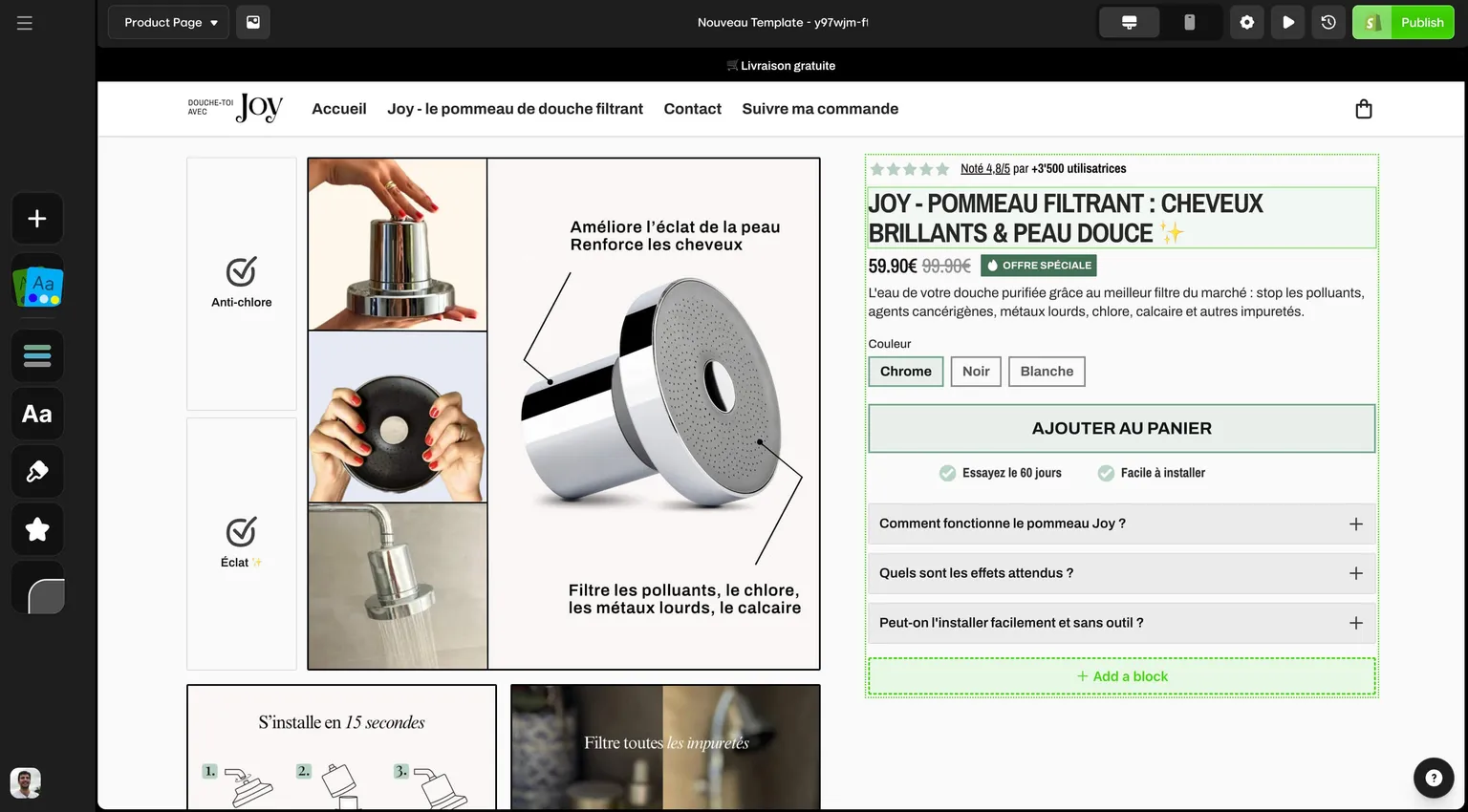
Everything is editable in a proprietary drag-and-drop visual editor: colors, typography, sections, marketing angles, and copy. When the store is ready, DropMagic publishes it directly to your own Shopify account.
The business model is the wedge. DropMagic is free to generate, customize, and iterate. There is no monthly subscription to build, no daily page limits, and no store caps. You only pay when you are satisfied and ready to publish. You can test unlimited concepts and invest only when you have a store worth launching — the opposite of committing to a subscription before you have seen the output.
Nas.com vs DropMagic: Two Different Bets on Where Your Store Lives
Strip away the feature lists and the two products are making opposite bets. Nas.com bets that sellers want everything in one place and will happily live on the platform to get it. DropMagic bets that sellers want to own what they build and keep it on the infrastructure the rest of ecommerce runs on. Here is how that plays out across the decisions that actually matter.
1. Platform vs. a Store You Own
This is the whole comparison in one line. On Nas.com, your storefront is a page inside Nas.com. It is hosted there, it renders there, and it exists as long as your subscription does. Nas.com is explicit and fair about the parts you do own — your customer data and your product catalog are yours, and there are no added fees on physical sales.
But the store itself is not portable. If you stop paying, or you outgrow the platform, or you simply want to move, you cannot pick up your storefront and take it somewhere else. You would rebuild.
DropMagic inverts this. The store it generates is published to your Shopify account, which you own outright. Your theme, your content, your customer relationships, and your checkout all sit on infrastructure you control and can move, export, or hand to a developer at any time. DropMagic is the tool that builds the store; it is not the landlord the store lives with.
For a weekend side project, platform convenience wins. For a business you intend to grow and possibly sell, ownership is not a nice-to-have — it is the asset.
2. Where Your Store Lives: The Shopify Ecosystem
Owning your store on Shopify is not just a philosophical point; it is an operational one. Shopify powers millions of merchants across 175-plus countries and offers an app ecosystem of 8,000-plus apps for email, reviews, upsells, subscriptions, shipping, and analytics.
That ecosystem is the reason a store can scale. Need email flows? Install Klaviyo. Want product reviews? Add Judge.me. Need advanced fulfillment or a loyalty program? There is an app, and it plugs into a store you own.
Nas.com's all-in-one design is the trade-off in reverse: you get the tools Nas.com built, and only those. That is cleaner at the start and more limiting later. When your growth depends on a tool Nas.com does not offer, you are waiting on their roadmap rather than reaching for one of thousands of integrations. If you are weighing platforms broadly, our guide to the best ecommerce platform for dropshipping walks through why that ecosystem depth matters as volume grows.
3. AI: Photo-to-Storefront vs. Persona-Based Design
Both tools are genuinely AI-native, but they point their AI at different problems.
Nas.com's AI is optimized for speed and breadth: one photo in, and it produces a storefront, an offer page, ad creative, and social content. The magic is how much of the whole business it spins up at once. The design itself is standardized — the AI fills a consistent platform layout so that every Nas.com store works and loads cleanly.
DropMagic's AI is optimized for differentiation. It generates a unique design per store and writes persona-targeted copy rather than generic product blurbs. The bet is that a store which looks and reads like it was made for a specific buyer converts better than one that looks like every other store on the same platform. In a market where roughly 70% of shopping carts are abandoned — the long-run average across ~50 studies compiled by the Baymard Institute — the quality of your page and its message is not cosmetic. It is the difference between a sale and a bounce.
Neither approach is wrong. If you value getting something live in minutes with zero decisions, Nas.com's photo-to-storefront is remarkable. If you value a store that stands apart and speaks to a defined audience, DropMagic's persona engine is built for that. For a deeper look at how this applies to product-URL imports, see our AI dropshipping store builder guide.
4. Built-In Ads: Nas.com's Real Edge
Credit where it is due: Magic Ads is something DropMagic does not do, and for the right seller it is a compelling reason to choose Nas.com. Launching Meta campaigns from inside the same dashboard that hosts your store, without learning Ads Manager, genuinely lowers the barrier to paid traffic.
Two caveats keep it honest. First, Magic Ads carries a 10% fee on the campaign (on the Pro plan; Platinum halves it to 5%), charged on top of your actual ad spend — so at scale, the convenience is not free. Second, "AI runs your ads" is easier to promise than to profit from; paid acquisition is hard whoever presses the button, and a fee on spend is a fee whether the campaign wins or loses.
DropMagic takes the opposite stance on scope: it builds the best possible store and leaves advertising to Shopify's ecosystem, where you can run Meta, TikTok, or Google campaigns through dedicated apps and pay the ad platforms directly, with no percentage skim on your spend. Fewer built-in shortcuts, more control over the economics.
5. Pricing & When You Pay
The headline numbers are close, but the shape of the cost is completely different.
Nas.com asks you to subscribe before you see much: a 7-day trial, then $9/month (Basic) or $29/month (Pro) to keep the store live, plus the 10% Magic Ads fee if you advertise on Pro. It is affordable, and the 0% physical-product fee is real. But you are paying a recurring fee to keep a store that lives on their platform, from month one.
DropMagic asks you to pay only when you have something worth publishing. Building, editing, and testing are free with no time limit. You generate stores, refine them, and decide — then pay at publish. There is no subscription clock running while you experiment, and no fee if you never launch a particular concept.
For a seller who is sure they are launching and wants ads bundled in, Nas.com's subscription is a fair price for a lot of tooling. For a seller who wants to see the output before committing a cent — the majority of people testing a first store — DropMagic's "free to build, pay at publish" model removes the risk entirely. It is the same logic behind our StoreBuild AI vs DropMagic comparison: try before you pay beats commit before you see.
6. Best For: Creators vs. Sellers Who Want to Scale on Shopify
Nas.com is built for creators and solo sellers with their own physical or digital products who want one platform to run everything. It shines for coaching, courses, handmade goods, and creator merch — audiences the founder's own following exemplifies.
DropMagic is built for people who want a real, ownable Shopify store — especially anyone doing product-URL-based dropshipping, where you need supplier apps, fulfillment integrations, and room to scale. Nas.com has no native supplier or product-import network, so for classic dropshipping, sourcing and fulfillment are on you. A store on Shopify connects to DSers, Zendrop, and the rest of the fulfillment stack that dropshipping actually runs on.
Side-by-Side Comparison
| Feature | Nas.com | DropMagic |
|---|---|---|
| What it is | All-in-one selling platform | AI store builder for Shopify |
| Where your store lives | Hosted on Nas.com | Your own Shopify account |
| Store ownership / portability | Data yours; storefront stays on platform | Store fully yours, portable on Shopify |
| Free to build | 7-day trial, then paid | Yes — free to build, edit, test |
| Monthly cost | $9 (Basic) / $29 (Pro) | $0 to build (pay at publish) |
| AI store generation | Photo-to-storefront | Product link or description to full store |
| AI copywriting | Magic Content (general) | Persona-based (age, interests, tone) |
| Design output | Standardized platform layout | Unique AI design per store |
| Built-in ads | Magic Ads (Meta), 10% campaign fee | Via Shopify ad apps (no platform skim) |
| Transaction fees | 0% on physical products | None (runs on your Shopify) |
| App ecosystem | Nas.com tools only | Shopify's 8,000+ apps |
| Best for | Creators, coaches, handmade sellers | Dropshippers and brands scaling on Shopify |
| Try before you pay | No — subscribe first | Yes — build free, pay at publish |
The table makes the trade explicit. Nas.com is a more complete platform out of the box — ads, content, and payments included — for a modest monthly fee. DropMagic is a more open foundation: a free-to-build, uniquely designed store that you own on Shopify and scale with the largest app ecosystem in ecommerce. In a global dropshipping market that reached roughly $464 billion in 2025, that portability and room to grow is not a small consideration.
Who Should Choose Which
Choose Nas.com if:
-
You are a creator, coach, or handmade seller who wants one dashboard for store, content, and ads
-
You want the absolute fastest path from a product photo to a live storefront
-
Built-in Meta advertising without learning Ads Manager is a priority
-
You are comfortable that your storefront lives on Nas.com's platform
-
A $9–$29/month subscription with 0% physical-product fees fits your plan
Choose DropMagic if:
-
You want to own your store and keep it on your own Shopify account
-
You are dropshipping or building a brand you intend to scale with supplier and marketing apps
-
You want a unique AI design and persona-based copy, not a standardized platform layout
-
You want to build and test for free and only pay when you publish
-
You value portability and no platform lock-in over an all-in-one bundle
Verdict: Convenience vs. Ownership
Nas.com is a genuinely good product, and this comparison should not be read as anything else. It is well-funded, well-built, and, for the creator selling their own goods, delightfully simple. If your priority is launching fast with ads and content bundled in — and you are happy for your store to live on Nas.com — it is a defensible choice at a fair price.
But most people searching for an AI store builder are not looking to rent a storefront. They are trying to build a business they own. That is the line this decision comes down to. Nas.com gives you a store on their platform; DropMagic gives you a store you own on Shopify — portable, scalable, and plugged into the 8,000-plus-app ecosystem the rest of ecommerce runs on.
And DropMagic lets you prove it costs you nothing to find out. Paste a product link, define your audience, and get a unique, conversion-focused Shopify store with persona-targeted copy and AI imagery — for free, with payment only when you publish. Nas.com asks you to subscribe to see what you get. DropMagic shows you first.
→ Try DropMagic for free
FAQ
What is Nas.com?
Nas.com is an all-in-one commerce platform from Nas Daily creator Nuseir Yassin, rebranded from Nas.io in April 2026 after a $27 million Series A led by Khosla Ventures. It lets solo sellers snap a product photo and have AI generate a hosted storefront, checkout, and offer page, then run Meta ads and content from the same dashboard. It is a full platform you sell on, not a Shopify app.
Is Nas.com the same as Nas.io?
Yes. Nas.io rebranded to Nas.com in April 2026 to signal its move from a digital-products and community tool to a full commerce platform for physical and digital goods. Existing Nas.io accounts, storefronts, products, and customer data migrated automatically, and old Nas.io links redirect to Nas.com.
Nas.com vs DropMagic — which should I choose?
Choose Nas.com if you want one hosted platform that handles your storefront, payments, and ad campaigns in a single subscription, and you are comfortable that your store lives on their infrastructure. Choose DropMagic if you want to own your store, publish it to your own Shopify account, and avoid platform lock-in. DropMagic is also free to build, so you can generate and test a full store before paying anything.
How much does Nas.com cost?
Nas.com starts with a 7-day free trial, then a Basic plan at $9/month. The Pro plan is $29/month and adds Magic Ads, which run Meta campaigns for you at a 10% fee on the campaign, plus more AI credits. A higher Platinum tier adds on-demand payouts, lower digital fees, and halves the Magic Ads fee. Nas.com charges 0% added transaction fees on physical products across all plans, though payment-gateway fees still apply.
Do you own your store on Nas.com?
You own your customer data and your products, and Nas.com charges no added fees on physical sales. But the storefront itself lives on the Nas.com platform, so if you stop paying or decide to leave, you cannot pick up the store and move it the way you can with a store you own on Shopify. DropMagic generates a store that publishes to your own Shopify account, so the store, theme, and content stay yours.
Can you use Nas.com with Shopify?
No. Nas.com is a standalone platform that replaces the need for Shopify, Etsy, or TikTok Shop rather than plugging into them. If you want your store on Shopify, DropMagic is the better fit: it builds a complete store and publishes it directly to your Shopify account, where you keep access to Shopify's 8,000-plus app ecosystem.
What is Magic Ads on Nas.com?
Magic Ads is Nas.com's built-in advertising tool. It launches Facebook and Instagram campaigns in a few clicks without Meta Ads Manager, using AI to build the creative and targeting. It is a real strength for sellers who do not want to learn ad platforms, but it charges a 10% fee on the campaign on the Pro plan, on top of your actual ad spend.
Is DropMagic free?
Yes. DropMagic is free to generate and customize stores. You paste a product link or describe your product, and the AI builds a complete Shopify store with unique design, persona-based copy, and AI-generated images. You only pay when you are satisfied and ready to publish to Shopify, with no monthly subscription required to build.
Is Nas.com good for dropshipping?
Nas.com is built more for creators and solo sellers offering their own physical or digital products than for classic dropshipping. It has no native supplier or product-import network, so sourcing and fulfillment are on you. For dropshipping specifically, a store on Shopify connects to supplier apps like DSers and Zendrop, which gives you more room to source, fulfill, and scale, which is the model DropMagic builds toward.